
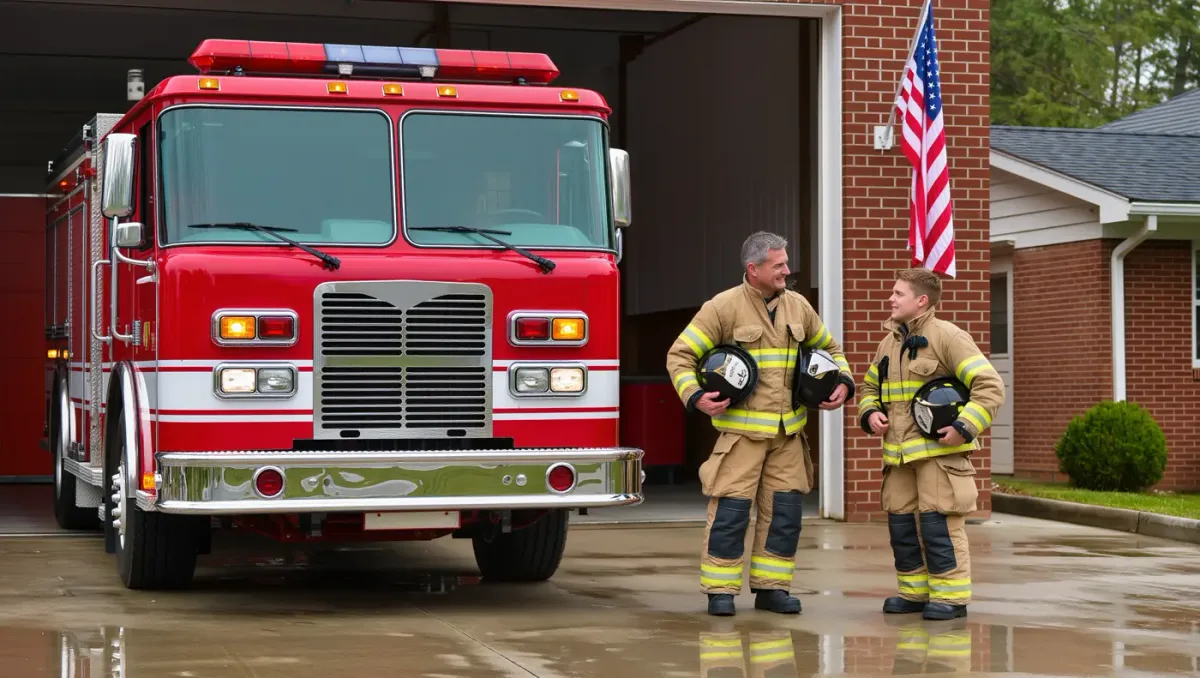
If you call 911 about a house fire in New City or a car fire in Suffern, the crew that shows up is most likely unpaid. Rockland County's fire service is built on volunteer companies organized into fire districts across Clarkstown, Ramapo, Orangetown, Haverstraw and Stony Point, supported by a small number of career firefighters where municipalities have chosen to hire them. Here is how the system works and what it takes to join.
Who runs the fire departments?
Fire coverage in New York State is organized at the fire district level. A fire district is a special-purpose district with its own elected board of commissioners, its own budget, and legal authority to raise money through property taxes. Inside each district are the individual fire companies — the volunteer organizations with names, histories, trucks and firehouses that most residents recognize.
Rockland is divided into multiple fire districts, generally aligned with villages and neighborhoods: for example, separate districts serve the villages of Nyack, Suffern, Spring Valley, Haverstraw and the hamlets of New City and Stony Point. Each district board sets policy and manages finances, while the companies recruit members, run drills and answer alarms. When multiple districts respond to a serious incident, a countywide mutual aid system coordinates who sends what.
Who pays for it?
Property owners do, whether or not they realize it. Fire district budgets appear as a separate line on town and village property tax bills, distinct from general town taxes and school taxes. That money buys apparatus, turnout gear, fuel, insurance, firehouse maintenance and training.
Because volunteers provide the labor, the tax burden stays far below what a fully career department would cost. Some districts and municipalities also fund modest incentives — programs such as Length of Service Award Programs (LOSAP), which set aside retirement-style benefits for volunteers who meet annual service requirements, and in some cases property tax exemptions or free access to services. Details vary by community, so check with your own district.
What does "call volume" mean?
Call volume is the number of incidents a department is dispatched to in a given period, usually counted per year. It includes structure fires, but those are a small share. Most alarms are automatic fire alarms, carbon monoxide detectors, motor vehicle crashes, wires down, brush fires, water leaks and medical assists where firefighters arrive before an ambulance.
Call volume matters for two reasons. It drives a department's budget and apparatus needs, and it determines what membership actually looks like: in busy districts, volunteers may be paged out several times a day, while quieter companies might run a handful of calls a week. Officials in Rockland and across the Hudson Valley have talked for years about rising call volumes and falling membership, which is why recruitment gets steady attention.
Related stories: Neighborhood associations in Rockland County: how streets organize and town boards listen · Suffern's farmers market and Rockland's market season: how they work.
What do volunteers actually do?
More than fight fire. A volunteer's commitments include:
- Responding to alarms at any hour, often leaving dinner or bed to drive to the firehouse
- Weekly or biweekly drills on apparatus, hose lines, ladders and search techniques
- State-required training courses, taken at the company or at the Rockland County Fire Training Center in Pomona
- Fundraising, open houses and fire prevention demos at schools
- Support roles: fire police who direct traffic at scenes, drivers and engineers, and auxiliary members who handle logistics
Not everyone rides the truck, and that is the point. If you want to serve but cannot commit to interior firefighting, there are exterior and support roles that keep a department running.
How do you join?
The process is similar across Rockland's departments.
- Contact a company directly at its firehouse, through its website or social media, or through your town or village hall, which can point you to the district covering your address.
- Fill out a membership application and consent to a background check.
- Complete a physical clearance as required by the department.
- As a probationary member, take entry-level firefighting coursework and begin responding and drilling with the company.
Minimum ages follow state law: juniors can generally begin at 16 with parental consent and restrictions on hazardous duties, and full interior membership starts at 18. You do not need prior experience — departments train new members from zero. Ask about what your town offers in return, because LOSAP benefits, tax exemptions and equipment provisions differ by municipality.
How mutual aid and the dispatch chain work
When you dial 911 in Rockland, the call goes to the county emergency communications center, which pages out the district covering that address and, depending on the incident type, neighboring companies as well. A working structure fire typically brings multiple engines, a ladder or truck company, a rescue, a fire police detail and an ambulance under a single incident commander. The county fire coordinators and mutual aid plan formalize this so no single company has to staff every scenario alone.
For residents, the practical takeaway is simple: the department nearest your house may not be the only one at your emergency, and the response you get is the product of agreements negotiated between districts years ago. Those agreements, like budgets, are discussed in public meetings.
Why it matters to the tax bill
Every resident of Rockland lives in a fire district, so every property owner is already a stakeholder. District budgets are public, commissioner elections happen annually, and boards hold regular meetings residents can attend. If your district has been discussing a new engine, a firehouse repair or a merger with a neighboring company, those decisions show up in your tax line — and volunteers who show up to meetings get a say before they do.
The short version: the siren you hear on a weeknight in Spring Valley or Valley Cottage is neighbors responding to neighbors. The system survives on taxes, training and people willing to be paged out at 2 a.m. If you have ever considered it, any firehouse in the county will take the conversation from there.