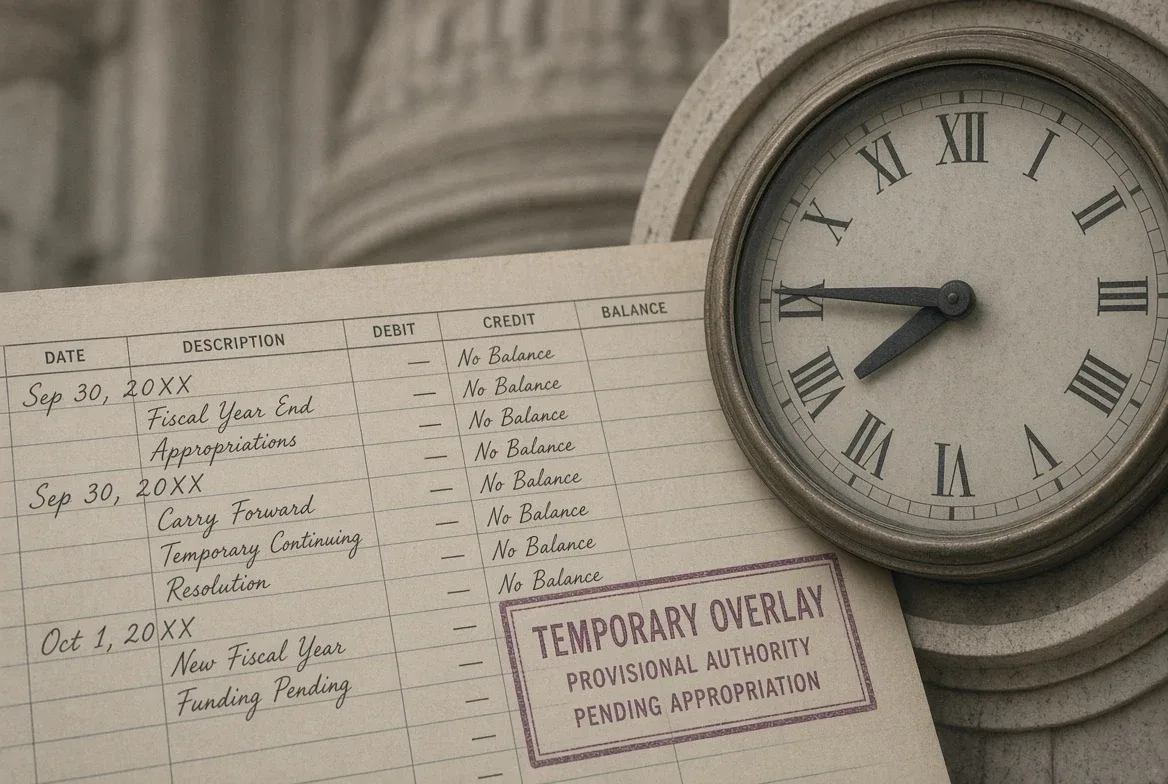
Continuing resolutions keep federal agencies open by carrying forward last year's funding rates when Congress misses its October 1 deadline for new appropriations — a stopgap, not a substitute, that freezes most programs at prior levels and blocks new starts unless lawmakers attach a specific exception, or "anomaly," to the bill.
How does a continuing resolution actually work?
A CR is a temporary appropriations bill that funds the government at a rate tied to the prior fiscal year rather than a fresh spending plan. A Government Accountability Office explainer describes a continuing resolution as allowing agencies to operate "when final appropriations have not been approved by Congress and the President," typically by continuing prior-year funding levels or the amounts set in an earlier CR. Lawmakers can modify that baseline for a specific account, extend an expiring program authority, or write in a dollar figure for one line item, but the default is to hold everything else flat. If Congress never finishes final bills before the fiscal year ends, a full-year CR functions much like a regular appropriations act for the rest of the year.
The mechanism matters because flat funding is not neutral. An agency facing a scheduled pay raise or a new program mandate gets neither under a bare CR unless Congress adds language covering it. That is the anomaly process: individual carve-outs negotiated account by account that let a handful of programs move while the rest of government stays frozen at last year's numbers.
In practice, a CR does one of three things to any given account:
- Holds it flat at the prior year's rate, with no adjustment for inflation, workload growth, or new mandates.
- Carries an anomaly that raises, lowers, or restructures that specific account's rate for the duration of the CR.
- Leaves a brand-new program or "new start" entirely unfunded, since CRs generally cannot fund activity that did not exist in the prior year's appropriations act.
Why does Congress rely on CRs so often?
Stopgaps are the norm, not the exception. GAO testimony to Congress, GAO-18-368T, found that lawmakers had relied on continuing resolutions to fund the government in all but four of the previous 40 years — a pattern GAO called a recurring driver of management problems inside agencies rather than a one-off budget hiccup. The structural reason is the calendar: the House and Senate must agree on separate appropriations bills, reconcile differences between chambers, and secure a presidential signature, all before October 1, a sequence that has rarely finished on schedule regardless of which party holds the majority.
What does operating under a CR cost agencies?
The costs show up in contracting and staffing, not in headlines. GAO's testimony cites the Bureau of Prisons, which in 2009 estimated that delaying a facility contract during a CR cost roughly $5.4 million in lost savings because officials could not lock in lower prices while funding stayed uncertain. The Food and Drug Administration reported that funding uncertainty under repeated CRs constrained its ability to hire and train inspectors, directly limiting inspection capacity. When a CR lapses entirely into a shutdown, the effect scales up: the Bureau of Economic Analysis estimated that the 16-day lapse in October 2013 cut real GDP growth by 0.3 percentage points in that year's fourth quarter. GAO's finding covers CRs enacted under both parties' majorities over four decades — the pattern is structural, not partisan.
The disruption is not limited to procurement offices. A GAO blog post on CR mechanics catalogs how the effect ripples across departments: staff at the Department of Health and Human Services have had to repeatedly prepare shutdown contingency plans instead of doing regular program work, the Department of Agriculture has seen CRs slow hiring and disrupt training pipelines, and the Department of Education has cited travel restrictions under CRs that limit staff's ability to monitor grant recipients in the field. None of these show up in a headline about a bill passing — they show up months later in agency workload.
What happens if no CR passes at all?
Absent any CR, the Antideficiency Act — not agency discretion — decides what stops. GAO's guidance on lapses in appropriations states that once funding lapses, agencies must "generally stop their operations," since the law bars spending, including paying employees, without an enacted appropriation. Two narrow categories keep functioning: work funded through multi-year or permanent appropriations, such as Social Security payments, and activities "excepted" as necessary to protect human life and government property under 31 U.S.C. § 1342. GAO's guidance is explicit that this exception carries a narrow scope and does not cover routine government functions simply because they matter — the legal test is protection of life and property, not public convenience. Work to end the lapse itself, including drafting new appropriations legislation, is not suspended. GAO points readers to its own "Principles of Federal Appropriations Law" — the reference lawyers inside agencies use to decide, account by account, which activities qualify as excepted.
Can agencies do anything to manage the uncertainty?
GAO's testimony identifies two partial fixes, neither of which eliminates the underlying disruption. Congress can write legislative provisions into a CR that give agencies more flexibility than a bare flat-rate extension — the anomaly process described above, expanded deliberately rather than negotiated account by account under pressure. Separately, agencies themselves can shift contract cycles later in the fiscal year, timing major awards for months when a CR is less likely to be in effect, so a stopgap does not stall a procurement already underway. Both approaches manage the problem; neither removes the core distortion GAO has documented for decades — that funding tied to last year's numbers cannot reflect this year's costs or priorities.
What should readers watch for in the next CR?
For anyone tracking a specific agency, the tell is not whether a CR passed but what it excludes. Compare the anomaly list in the enacted text against the prior year's full appropriations act: any account without a carve-out is frozen, any program awaiting a new start stays on hold, and any agency citing "funding uncertainty" in a delayed procurement is describing exactly the dynamic GAO's testimony documented — contracts pushed later, hiring paused, and costs added rather than saved.
For a related policy news perspective, read A Game-Changing Platform for Independent Writers.
For more context, read How New York's property tax levy cap actually works.
For more context, read The Six-Day Deadline That Makes an Election Official.
For more context, read Rockland County's property assessment calendar, explained.