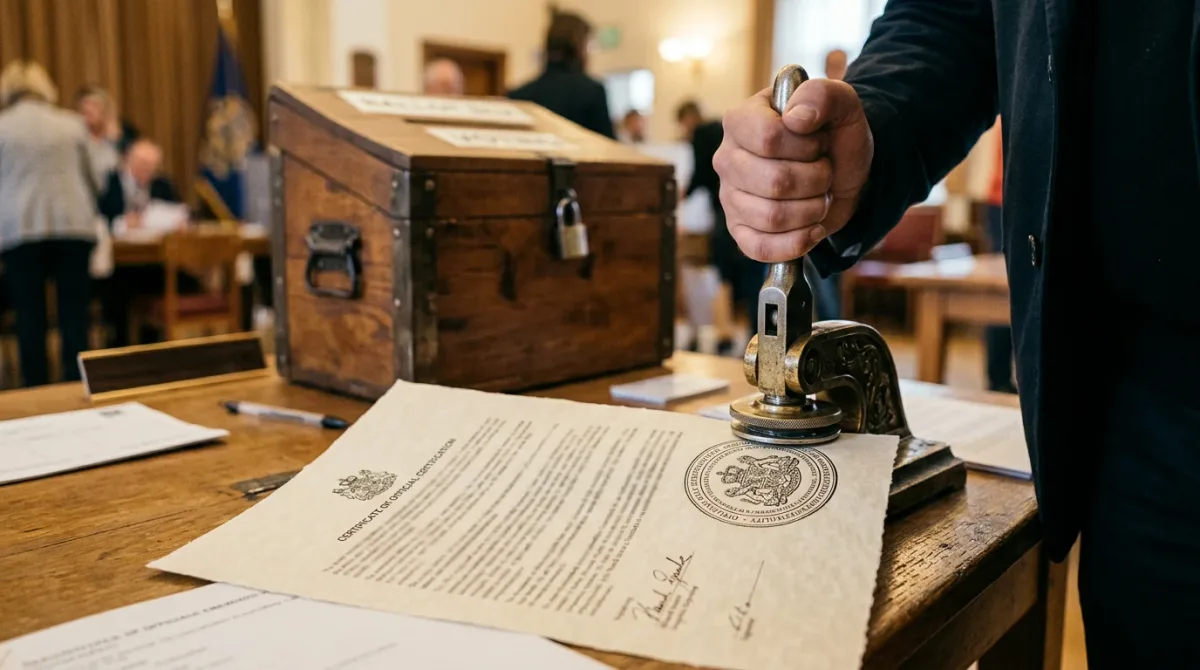
Certification is the formal act, performed by a named state or local official, board, or in some states a legislative body, of attesting that reported vote totals are a true and accurate accounting of every valid ballot cast; it follows a canvass that reconciles ballots against voters and, in most states, a post-election audit of the voting equipment.
Every election-night broadcast graphic that reads "100% precincts reporting" is describing an unofficial count. The U.S. Election Assistance Commission (EAC), the federal agency that supports state and local election administration, says plainly that even a complete report on election night is "still unofficial," because the canvass and certification steps that follow have not yet happened, according to the EAC's guidance on election results, canvass, and certification. The Congressional Research Service (CRS) puts the gap in concrete terms: finalizing federal election results "typically can occur days or weeks after election day," as officials at every level work through canvassing and, where required, audits and recounts.
What Is the Canvass, and What Does It Actually Check?
The canvass is the process, run by state and local election officials, that reconciles every mail, early, Election Day, and provisional ballot against the record of who voted, confirming that every valid vote is included in the reported totals and that the count matches the number of participating voters, per the EAC.
It is not a recount in the sense of re-running ballots through tabulators; it is a reconciliation and verification step. Most states pair it with a separate post-election audit that checks whether voting equipment counted ballots correctly, though the EAC notes that "the timing and method of post-election audits differ among states." Officials build a paper and digital trail during the canvass — chain-of-custody logs, provisional-ballot rulings, signature-cure resolutions — that later stands behind the certified number if a result is challenged.
Who Has the Authority to Certify a Result, and When?
Certifying authority varies by state and sometimes by office within a state: a single elected official such as a secretary of state, a governor, an appointed election director, or a multi-member board can hold that power, the EAC explains. Local certification — by a county auditor, municipal clerk, or county board — typically happens first, feeding into a state-level certification for statewide and federal races.
There is no single national certification date. State law sets each jurisdiction's own deadline and process, and, per the EAC, "state and local election officials are the authorities on election certification dates." The CRS report on federal election results confirms the same pattern: all states and territories that administer federal elections follow broadly similar steps — canvass, verification, certification — but each sets its own timeline for completing them.
How Does a Recount Change the Timeline?
A recount, an additional count of already-cast ballots to confirm accuracy, can push certification back, and state law controls both when a recount can be requested and how it affects the certification date. The EAC lists the usual triggers: a candidate requests one, a voter who cast a ballot requests one, the margin falls inside a state's legally defined automatic-recount threshold, or a court orders one; a requesting candidate or voter may also have to pay a fee or the recount's cost, depending on the state.
States sequence the two steps differently. The EAC cites New Hampshire, where state certification happens only after the deadline to request a recount has passed, and West Virginia, where counties must certify within 30 days of the election — or, if a recount is underway, within 30 days of the recount's completion. There is no federal timeline that governs recounts generally. But for presidential contests, any recount still has to resolve before the separate federal deadline described below.
Why Do Presidential Elections Carry an Extra Deadline?
Presidential races add a federal layer on top of each state's own certification process because the vote is technically for a slate of presidential electors, not for the candidates directly. Federal law, 3 U.S.C. §5, requires the "executive of each State" — ordinarily the governor — to issue a certificate of ascertainment naming the state's appointed electors "not later than the date that is 6 days before the time fixed for the meeting of the electors."
That meeting date is itself fixed by a separate statute, 3 U.S.C. §7: electors meet and cast their votes "on the first Tuesday after the second Wednesday in December" following their appointment. Congress amended §7 in 2022, through the Electoral Count Reform and Presidential Transition Improvement Act, moving the meeting from the first Monday to the first Tuesday after the second Wednesday in December and tying the electors' meeting date to "the laws of the State enacted prior to election day," according to the statute's text as published by the Government Publishing Office. Under §5, a certificate issued through that process is treated as conclusive when Congress counts electoral votes, unless a court order requires a revised certificate before the electors meet.
The governor's office must also send the certificate to the U.S. Archivist immediately by the fastest available method and deliver duplicate originals to the state's own electors by the meeting date, per §5(b). The six-day cushion exists so that a state's electors, and the federal government, have a settled, single document naming who was appointed before the electors actually vote — even if a recount or legal dispute over the certificate is still working through the courts up to that point.
What Happens After a State Certifies?
Certification does not close every door. Losing candidates in most states retain the right to challenge results in court after certification, through an election contest, and a court can in some circumstances order a revised certificate. But under 3 U.S.C. §5, only a certificate "issued or revised by any State or Federal judicial relief granted prior to the date of the meeting of electors" can replace an earlier one for presidential purposes — meaning the electors' meeting date, six days after the certification deadline, functions as a hard cutoff for that particular kind of correction.
For every other office, state law governs how long an election contest can run and what remedy a court can order, and that process sits entirely outside the federal statutes described here.
FAQ
Why do election-night results say "100% precincts reporting" but still count as unofficial?
Because the canvass — reconciling every mail, early, Election Day, and provisional ballot against the list of voters — has not yet happened; the EAC says results stay unofficial until officials complete that process and issue a written certification.
Who certifies a state's election results?
It depends on the state: a secretary of state, governor, appointed election director, or a multi-member board can hold certifying authority, and local officials such as county auditors or clerks typically certify first, per the EAC.
Does requesting a recount automatically delay certification?
Effects vary by state. The EAC notes New Hampshire certifies only after the recount-request deadline passes, while West Virginia gives counties 30 days from the election, or 30 days from a recount's completion if one occurs.
What is a certificate of ascertainment?
It is the document a governor issues under 3 U.S.C. §5 naming a state's appointed presidential electors and the vote totals behind that determination, due at least six days before the electors meet under 3 U.S.C. §7.
Can a certified presidential result still be changed by a court?
Only within a narrow window: 3 U.S.C. §5 lets a revised certificate replace an earlier one solely if judicial relief is granted before the date electors meet.
For a related analysis perspective, read How Automatic Recount Thresholds Vary From State to State.
For more context, read Rockland County's property assessment calendar, explained.
For more context, read How a rezoning works in Union County, step by step.
For more context, read Continuing Resolutions: How Stopgap Funding Actually Works.