
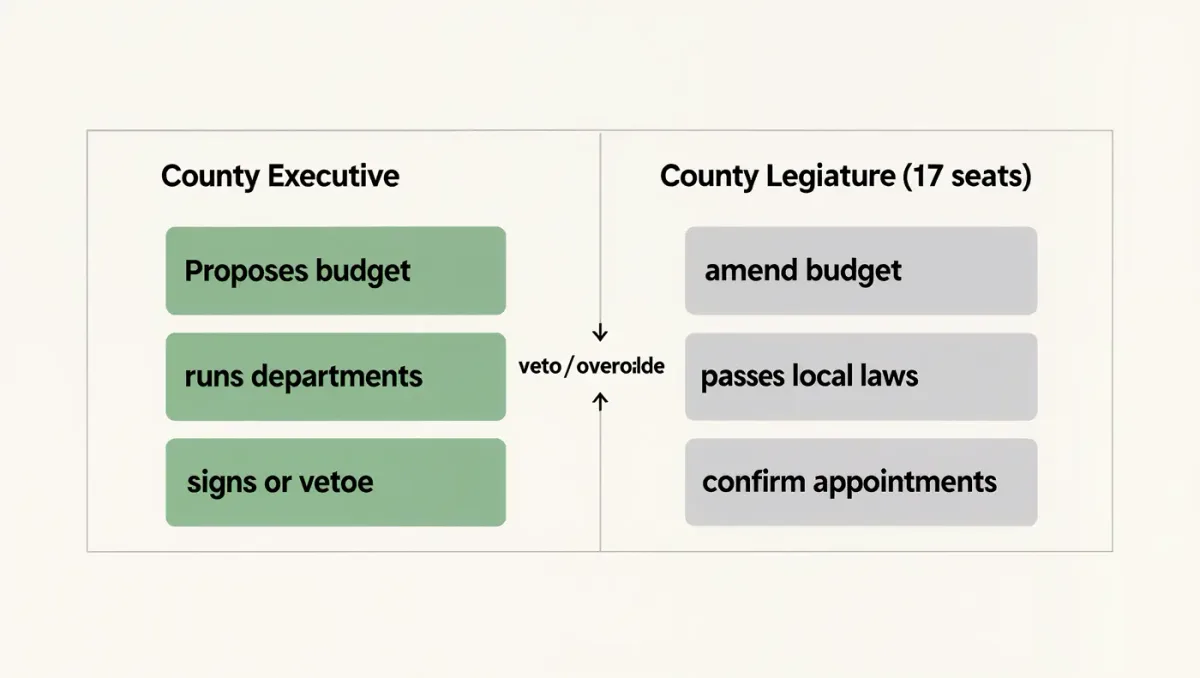
The Rockland County executive is the county's chief administrator: one elected official who proposes the county budget, runs the county's departments and can veto local laws the legislature passes. The legislature — 17 members representing districts from Clarkstown to Ramapo to the river towns — writes the laws and holds the purse. That split, created when Rockland adopted its county charter in 1985, means no single official controls county government alone.
What the office actually controls
The executive appoints and supervises the heads of county departments: the health department, the sheriff's non-civil-service leadership structure is separate, but departments like social services, highways, parks and planning answer to the executive through appointed commissioners. Day-to-day administration — executing contracts the legislature approved, managing county property, responding to emergencies — is the executive's job under the charter.
Appointments are a quieter power. The executive nominates commissioners and members of some county boards, and several appointments require legislature confirmation. Over a four-year term, those personnel choices shape how county services actually run in New City, Pomona and the county facilities residents use.
The budget role
Each year the executive submits a proposed county budget to the legislature. That document sets out the property tax levy, staffing levels and spending for every county function, and it is the single most consequential document the office produces. The legislature then holds hearings, amends and adopts a final budget — but the executive's proposal is the starting text, which gives the office enormous agenda-setting power.
Once the legislature adopts a budget or a local law, the executive signs or vetoes it. A veto returns the item to the legislature, which can override with a qualified majority under the charter. In practice, vetoes are rare because most items are negotiated before the vote — but the threat shapes what the legislature sends up.
Executive versus legislature
Residents often blame or credit the executive for decisions that actually belong to the legislature, and the reverse. The clean version of the split:
| Power | County executive | County legislature |
|---|---|---|
| Propose the budget | Yes — drafts the proposal | Amends and adopts |
| Pass local laws | Signs or vetoes | Yes — votes to pass |
| Run departments | Yes — daily administration | Oversight through committees |
| Appoint commissioners | Nominates | Confirms many |
| Set county policy direction | Shared | Shared |
Neither branch can spend money the other has not authorized: the executive cannot fund a program the legislature did not appropriate, and the legislature cannot force the executive's departments to administer a law without the administration carrying it out. Disputes between the two end up resolved in budget negotiations, confirmation votes or, occasionally, court.
Related stories: How the Rockland County Legislature works: 17 seats, votes and public hearings · The Rockland County budget calendar: when the executive proposes, the legislature decides, and you can speak.
How the office reaches daily life
County government touches residents in ways that are easy to miss. The county health department that inspects restaurants, the clerk's office that records deeds, the sheriff's road patrols outside village police areas, the maintainers of county roads like portions of Route 45 and the county park system — all sit inside the executive branch. The executive's management choices show up in practical ways: how fast a restaurant inspection is scheduled, how a snow emergency is coordinated across towns, whether a county park's hours expand.
That reach is also why the executive's budget proposal deserves attention from every town, not just New City. Shifts in county staffing ripple outward: fewer health inspectors means slower approvals for restaurants in Suffern and Spring Valley alike; highway funding changes show up on county roads in Orangetown and Haverstraw. Watching the fall budget hearings is the closest thing residents have to seeing next year's service levels before they happen.
Elections and term limits
The executive is elected countywide to a four-year term, unlike legislators, who run in districts every two years. That countywide mandate is why the office speaks for the whole county — in state negotiations, emergency declarations and inter-municipal agreements with towns like Clarkstown and Orangetown — while the legislature reflects district-level interests.
Emergencies and the limits of executive power
The office's visibility peaks during emergencies. Under state and county law, the executive can declare a state of emergency, issue orders such as travel restrictions during a storm, and direct emergency operations across the county. Those powers are temporary and narrow: they let the administration respond faster than a legislative process allows, but spending beyond appropriated funds still requires the legislature, and extended emergency measures draw Charter-based scrutiny.
The same checks apply in ordinary times. An executive cannot create a new county department, raise the tax levy or sign a multi-year contract without the legislature acting. When residents see a major announcement — a development agreement, a consolidation plan, a new county facility — the realistic question to ask is which resolutions the legislature has passed or will need to pass to make it happen. If none exist yet, the announcement is a proposal, not a decision.
How to follow what the executive is doing
Three public records cover most of it. The proposed budget, posted each fall before the legislature's hearings, shows the office's priorities in numbers. The legislature's agendas show which executive appointments and agreements need legislative approval. And the county's official website posts the executive's press releases, executive orders where issued and the charter itself. For a specific decision — a contract, an appointment, a veto — the paper trail runs through the legislature's minutes, because that is where every executive proposal gets formally accepted, changed or rejected.
Residents who want to influence a county decision should note the calendar: budget proposals drop in the fall, and the legislature's public hearings on them are the formal window for comment. By the time a veto fight makes news, the negotiation has usually been settled for weeks.