
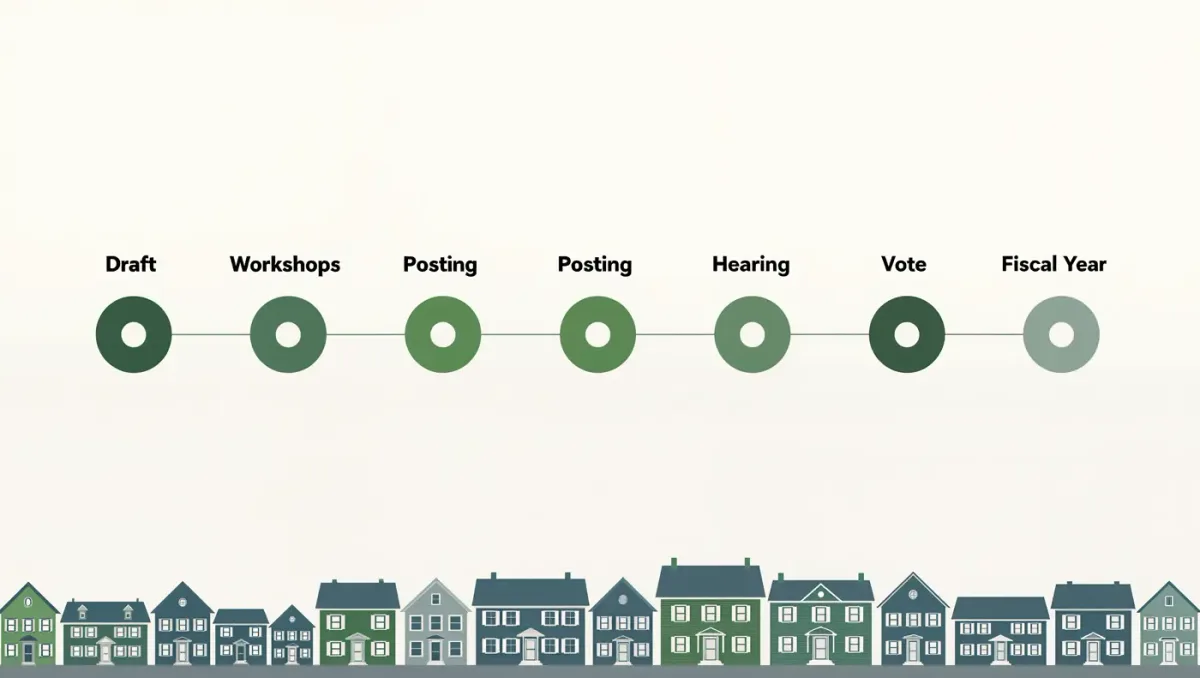
A village budget in Rockland County is drafted by village staff, reviewed and revised by the board of trustees, aired at a public hearing, and adopted by board vote before the village fiscal year starts on June 1. That is the whole machine. The details — who writes the first draft, when you get to speak, what a tax levy actually is — are where residents tend to get lost.
This guide follows the process step by step, using examples from villages like Nyack, Suffern, Spring Valley, West Haverstraw, and New Hempstead. Village halls differ in size, but the procedure under New York Village Law is largely the same in all of them.
Who starts the budget?
Each village designates a budget officer — often the village treasurer or clerk-treasurer — who assembles the tentative budget. In practice, department heads (highway, water, police where one exists, building, recreation) submit spending requests, and the budget officer folds them into a working document alongside revenue estimates.
The draft covers two sides of a ledger: what the village expects to spend and what it expects to take in. Most revenue comes from property taxes, but villages also count building permits, court fines shared with the county and state, state aid, franchise fees, and interest. Whatever revenue does not cover, the property tax levy does.
In small villages the treasurer and mayor may hash out the first draft across a kitchen table of spreadsheets; in larger ones like Spring Valley or Suffern, department heads present in work sessions. Either way, the first draft is internal — nothing requires it to be released publicly, though many villages post it once the board starts reviewing.
What the board of trustees does
The board of trustees — a mayor plus trustees in most villages — holds budget workshops where line items get questioned, trimmed, or moved. These work sessions are usually open to the public under the Open Meetings Law, but they are working meetings: residents can watch, and often speak only if the board allows comment.
This is where the real decisions happen. A trustee might ask why the snow-removal line went up, whether a new truck purchase can be bonded over several years instead of paid in cash, or whether a part-time position stays vacant another year. Because trustees answer to village voters — most Rockland villages hold elections in March — budget season is also political season.
What a tax levy means (and the cap)
The tax levy is the total amount of property tax the village collects — not the rate on your bill and not your individual tax. It is the gap between planned spending and all other revenue.
New York's property tax cap law limits how much a village can grow its levy without a local law approved by a supermajority of the board. The cap is not a flat 2 percent; it is a formula involving inflation and other factors, and the state comptroller publishes each village's allowable levy growth factor every year. Villages can and do override the cap, but they must vote to do so publicly, on the record, which is why the vote itself is worth watching.
One more wrinkle: an assessed value that drops while the levy stays flat can push your individual bill up. That is why a board saying the levy is flat is not the same as saying your bill is flat.
Related stories: Town justice courts in Rockland: what gets heard in your town hall, and what does not · The Clarkstown town board, explained: zoning, contracts and where to read the minutes.
The steps, in order
- Department heads submit spending requests to the village budget officer, usually in late fall or early winter.
- The budget officer assembles a tentative budget with revenue estimates and a proposed tax levy.
- The board of trustees holds budget workshops — open meetings where line items are debated and revised.
- The board sets a date for a public hearing on the budget, with advance notice posted at village hall and in the village's official newspaper or website.
- Residents speak at the public hearing; trustees may respond but typically do not vote that same moment unless the law and their local rules allow.
- The board votes to adopt the budget, either the same night or at a subsequent meeting, before the fiscal year begins June 1.
- The adopted budget and tax levy roll into the village tax bill, and the clerk files the budget with the state comptroller's office.
Where the public hearing fits in
The public hearing is the formal moment for residents. Under Village Law, the board must hold a hearing on the tentative or preliminary budget and must publicly post the budget in advance so people can actually read what they are commenting on. Speakers usually get a few minutes each. Written comments are also accepted.
Honest expectation-setting: hearings rarely flip a whole budget. But they do move line items. A few residents pointing out that a proposed fee doubles the cost of a recreation program, or that a road project skips a street that floods every year, can and does change how trustees vote on individual lines.
If you speak, bring specifics: the line item name and number from the posted budget, and what you want changed. Boards respond better to a sentence about a street or a service than to a general complaint about taxes.
What to look for in a village budget
Three numbers do most of the work. The first is total appropriations — the spending side — and whether it moved much from last year. The second is the tax levy, which tells you what property owners are being asked to cover. The third is fund balance use, meaning how much of the village's savings the board is spending to hold the levy down; that number is fine in a lean year and a warning sign several years running.
Also scan the revenue side for one-time items. A budget balanced with a single land sale or a lawsuit settlement is balancing next year with a hole in it.
How villages differ across Rockland
Nyack, Suffern, Spring Valley, West Haverstraw, and the county's other villages run the same statutory playbook, but scale changes the texture. A small village board may finish workshops in two evenings; Spring Valley or Suffern may spread them across weeks because of police, water, and parking district budgets folded into the picture. Villages that operate their own water or sewer systems carry utility budgets inside the general budget, which is why their levies look bigger than a village that buys county water at wholesale.
If your village has had disputes over budget process in the past — and several in Rockland have — the minutes of budget workshops are the best public record of who proposed what. New York's Open Meetings Law requires minutes to be posted within roughly two weeks of an executive session and sooner for open sessions.
Questions residents actually ask
Can I see the budget before the hearing? Yes — the posted notice must tell you where. Can the board change the budget after the hearing? Yes, and often does, in small ways. Does a village budget include school or county taxes? No — village taxes cover village services only; school, county, town, and special district taxes arrive on separate bills or separate lines.
The takeaway for any village resident in Rockland: the budget is drafted before you see it, but it is not finished until the trustees vote. The weeks between the posted draft and the hearing are when your input is worth the most.